The landmark 50th International Viola Congress took place in Paris (yes, France) from January 19th – 23rd, 2026. A day-by-day post-congress blog is delivered to you by Kristofer Skaug.
Day 3: Wednesday, January 21st, 2026
<previous day> <next day>
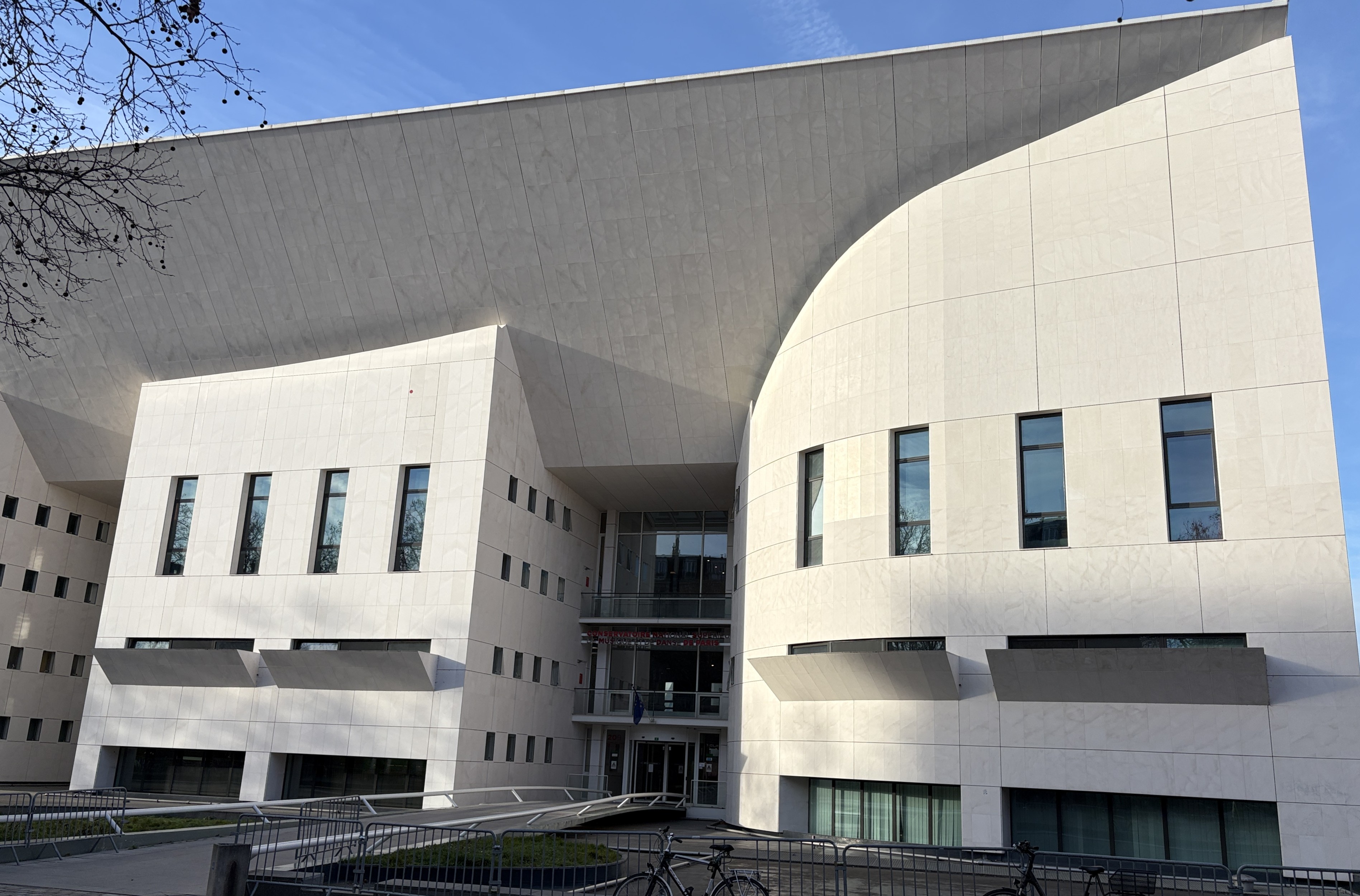 Today the epicentre of this congress shifted from the downtown CNSAD conservatory to a more remote site, the Conservatoire National Supérieur de Musique et de Danse de Paris (CNSMDP for “short”, pictured above), which is the main music conservatory of Paris situated in the North-Eastern part of town, flanking the Cité de la Musique, where the new Philharmonie de Paris is also located.
This morning’s Viola Orchestra rehearsal was cancelled due to the overwhelming interest in the masterclasses of Tabea Zimmermann and Kim Kashkashian, which took place simultaneously. We did not attend either of these, but headed straight for the session “Engaged Music” in the Ravel studio.
 Here, the first recital was “Paradise Lost, Voices Rising: Music and Poetry from Ukraine and Taiwan” by the duo Alto Nova (Emlyn Stam and pianist Sherry Grant). The world première arrangement of Valentin Silvestrov’s Kitsch Music , originally conceived in a very different era (1977), acquired a glow of its own against today’s backdrop of the Ukrainian war. The premiere arrangement of Fu Tong Wong’s “Taiwanese Aboriginal Suite” brought to mind the threat against this island and its native culture.
Seamlessly extending this program, the Taiwan Radiant Ensemble (Shu-Ching Hsu, viola; Sabina Shu-Chun Chiang, flute, and Chao-Pei Chen, harp) brought a recital with the title “Tides of Memory: Music Echoing Taiwan’s Historical Silence“, premiering three Taiwanese female composers’ works written for this ensemble. The program is said to “explore Taiwan’s cultural pluralism and its dialogue with France’s ideals of liberty and unity“. Some of this pluralism we were already fortunate to glimpse at the 2023 IVC in Thailand, where Hsu performed with a Taiwanese viola quartet. These new compositions were very satisfying, and add nicely to the already above-average repertoire for flute-viola-harp trio.
 The next session I attended was themed “Eastern Europe”, featuring two recitals from Poland. First, in “Poland meets Chile”, Wojciech Kolaczyk and Carola Fredes played viola duos from Poland and Chile, celebrating the emerging (albeit long-distance) intercultural union of these two countries. Their performance was enthusiastically received. Concluding the Polish recital, prof. Boguslawa Hubisz-Sielska (founder of the Polish Viola Society and twice IVC host) made an impression with the piece “Farewell” by Marcel Chyrzynski (originally for cello and piano). I had to miss her rendition of the Preludia taneczne by Lutoslawski, as a compromise was required to catch the next event at the CNSAD downtown.
 That event was the recital of prof. Pauline Sachse‘s Viola class from Hochschule für Musik und Theater (HMT) Leipzig, the oldest university conservatory in Germany, founded in 1843 by Felix Mendelssohn. Prof. Sachse had composed or arranged all the pieces in this programme. Appropriately, they started out with the arguably most famous Leipzig citizen, Johann Sebastian Bach. The “Goldberg variations” have already been popular for some time in a string trio arrangement, but here prof. Sachse had re-arranged it for three violas, reaching much farther toward abstractions and extended techniques than its string trio counterpart. This was a true joy to hear, I sincerely hope this version will be published some day!
Another fun surprise was the arrangement of the 3rd movement of Schumann’s Märchenbilder for viola quartet (!). It could be argued that it is easier when the four players get to share the strenuous fast triplets, alternating every few bars. But that instead creates a challenge at the handover points, to avoid disruption of the flow.
 Three students (Momoka Okada, Sophie Kiening and Gesine Hadulla) performed solo works written by prof. Sachse. I enjoyed most the piece “Hidden spaces“, which was an obvious big nod to Garth Knox, but had its own ideas as well. Finally the whole class took the stage in a celebratory “Dance” for 8 violas, with entertaining dialogues and catchy rhythms.
Time for the evening programme, which in our self-inflicted itinerary meant catching 3 concerts in about 5 hours on two different sites.
We first convened in the CNSAD main theatre, for a concert designed and performed by featured artist Garth Knox. He played two of his own solo compositions (New Spaces and Three Little Entropies), evocating curiosity and humour like only he can. He was then joined by none other than Kim Kashkashian in duos by Luciano Berio and himself. This first part of the concert conluded with pieces by Erik Satie, arranged for two violas and cello.
 After a brief intermission, Knox stayed (mostly) off-stage during the premiere of his commissioned work The Ancient Mariner, featuring Lawrence Power as soloist with the Ostinato string orchestra. This was a dramatic piece, where the orchestra also served as the ship’s crew, sailing this way and that, while the soloist struggled with curses thrust upon him (a dead albatross – please don’t ask me to explain the plot!). Anyway this concert remains one of my most vivid impressions from this congress.
 As much as we would have loved to stay and shout for encores, as soon as the applause swelled up, we had to run off to catch our appointment at Paris’ splendid new concert hall (opened in 2015), the Philharmonie de Paris, where Tim Ridout and Lorenza Borrani were playing their hearts out in Mozart’s Sinfonia Concertante. What a joy to hear Ridout, and Borrani was certainly a good match and a pleasant new discovery for me. Oddly enough, this exquisite concert was not part of the official IVC programme, although I think it may originally have been intended as such. The original announcement of the congress also alluded to hosting events at the Philharmonie, but in the end it seems this one fell off the wagon.
Continuing our cherry-picking tour through the musical landscape of Paris this evening, we left the Philharmonie behind as soon as Ridout had left the stage, rushing back to CNSAD to catch whatever might be left of IVC featured artist Tatjana Masurenko‘s recital. We were in luck, because her recital had been delayed, so we arrived just before the intermission, which was around 21:45h. And it became clear immediately how she set and owned the stage. It starts with her appearance, the fiery red hair and the cape. The chocolate textured viola sound with a red hot core.
 Her monumental performance of Rachmaninov’s one and only cello sonata had the late-night audience swoon. I literally heard sighs all around me as the final chord sounded off. In this day and age we’re conditioned to be cynical about any degree of romanticism beyond Netflix Christmas movies, but here it was: All or nothing. She conquered. I think I needn’t say more. Goodnight children, more tomorrow!
Disclaimer #1: Any opinion expressed here is the author’s own, not that of the DVS.
Disclaimer #2: Due to the incredibly rich programme at this congress, it was physically impossible to see (and hence report from) more than perhaps 25-30% of all the events. A high level summary (listing also all of the Dutch contributions) is given on this page, and more details can of course be found on the official congress website.
<previous day> <next day>